
 Français
 English
 Allemand







































































WOODY PERFUMES : Which warm and elegant notes should I choose to make my senses tingle?
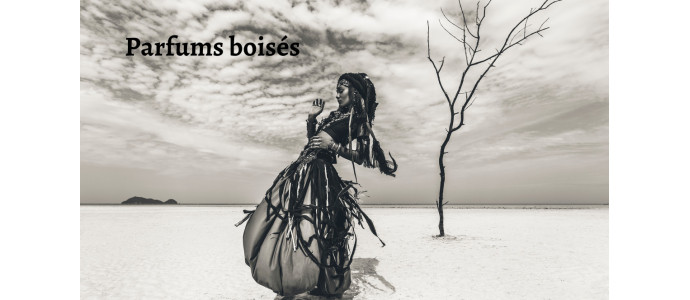
Woody Perfumes : Warm and Elegant Notes for a Sensory Trail
As the first damp chills of autumn set in, woody fragrances come to our rescue with their warm, noble vibrations. Their sensual, elegant, and refined notes delight lovers of charismatic and exclusive scents. But there’s more to these perfumes than just charm; their olfactory benefits are recognized by aromachologists who swear by them for reconnecting us to our core. Myrrh, incense, and vetiver are believed to help us focus on what truly matters, while sandalwood promotes relaxation and serenity. So, let’s draw inspiration from the famous Gallic saying, "touch wood" to ward off bad luck, and instead, "smell the wood"!
|
Present in perfumes since Antiquity, woody notes are an integral part of our human history. From the Bronze Age (2500-1000 BC), resins such as frankincense and myrrh were used in ritual fumigations in Mesopotamia and the Levant (Near East). While cedar oil was applied to the surfaces of the temples of Ur, myrrh accompanied every sacrificial procession in the Syrian kingdom. Far from being limited to sacred uses, their aphrodisiac, therapeutic, and hygienic properties also pleased the general populace, making them a symbol of social success. In Ancient Egypt (3150-31 BC), the cradle of perfumery, they were used in funerary rites and in complex perfume compositions like the famous "Kyphi" (the "twice good perfume"), the first aromacological perfume in history, or "Métopion" and "Mendès perfume," which Cleopatra (69-30 BC) supposedly wore to seduce Julius Caesar. Despite their major use for centuries and societal changes that relegated perfume to mere hedonistic |
dimensions from the 19th century onward, it wasn't until the late 1950s that woody notes were celebrated in modern perfumery. Guerlain, Givenchy, and Carven were among the first to launch festivities with their famous "Vétiver." This was followed by a plethora of other woody creations, including the well-known "Equipage" by Hermès (1970), "L'Autre" by Diptyque (1973), "Gentleman" by Givenchy (1974), "Grey Flannel" by Geoffrey Beene (1976), "Fahrenheit" by Dior (1988), "Egoïste" by Chanel (1990), and "Déclaration" by Cartier (1998). Women had to wait until the late 1980s (unless they borrowed their partners' fragrances) to have their own woody scents. "Samsara" by Guerlain and "Féminité du Bois" by Shiseido (now Serge Lutens) kicked off the trend and marked the beginnings of so-called "mixed" perfumes. Since its inception, the "woody" olfactory family has continued to inspire perfumers. Its diverse notes are unparalleled in structuring and enhancing a fragrance: |
whether they are warm and milky like sandalwood, dry like cedar, humid like patchouli and oakmoss, smoky like Haitian vetiver and guaiac wood, animalic like oud (or agarwood), or multifaceted like amber woods (those famous synthetic molecules such as cashmeran, ambroxan, and timbersilk that add volume, power, and longevity to compositions), they form the backbone of perfumes. Passionate about woody fragrances, Paris Parfums has delved into its treasure trove to offer you olfactory gems that blend classicism and modernity: "Féminité du Bois," "Chêne," and "Five O'Clock" by Serge Lutens, "Royal Oud" and "Tabarome" by Creed, the recent "Baïkal Leather Intense" by Patricia de Nicolaï created to celebrate the brand's 30th anniversary, and the delightful "Santal Blanc" (Extraordinary Collection by Van Cleef and Arpels), "Santal Majuscule" (Serge Lutens), and "Santal Kandy" (Boucheron). Don't hesitate to discover these unique creations on our website or in our stores in Thann and Mulhouse. |
If you enjoyed these words, please leave us a few lines in the COMMENTS below to support the emotional values of perfumery that we defend.
France has been the country of perfume since the 16th century. The raw materials, hand-picked one by one, arrived from all over the world, at the time, by mule, horse, or sailing boats, against all odds.
Today, large financial groups have taken over the profession and have only one value: making money by maximizing their investments as quickly as possible. This destroys all the charm and savoir-faire of French perfumery at the expense of internationalization! The money you give them evaporates miles away and finances investments in countries where they seek to establish themselves!
See you soon for another fragrant article or your future visit to our perfumeries.
.
Join us: our social media:
Join the community of true sensory perfume lovers on Parisparfums Facebook and Instagram (@parisparfumsfr) and stay informed about all the latest in the world of perfume.
In Same Category
Related by Tags
- THE 3 MUST-HAVE PERFUMES FOR MEN
- ARE YOU LOOKING FOR A PERFUME that’s soft and velvety? Discover the sensuality of mimosa
- WOMEN - MEN HOW TO WEAR PERFUME: The 6 Commandments for the Perfect Scent Trail
- WOODY PERFUMES : Which warm and elegant notes should I choose to make my senses tingle?
- SENSUALITY and WARMTH of autumn fragrances for women and men